Hi,
Hi,

The pumps stand silent. Cars stretch in motionless lines toward the horizon. A refinery glows against a smoke-choked sky the color of rust and fire. A simple handwritten sign delivers the final verdict: “SORRY OUT OF GAS.”
This is not a cinematic warning. This is the global energy crisis materializing in real time. It did not begin with soaring prices at the pump. It began with supply fracturing at its core. Most of the world has not yet absorbed the full force of what is coming. Central banks, however, already understand. While politicians and markets chase fleeting headlines, the institutions that guard national wealth are moving with quiet precision: accumulating gold at scale and then deploying it without hesitation when fiat currencies falter under pressure.
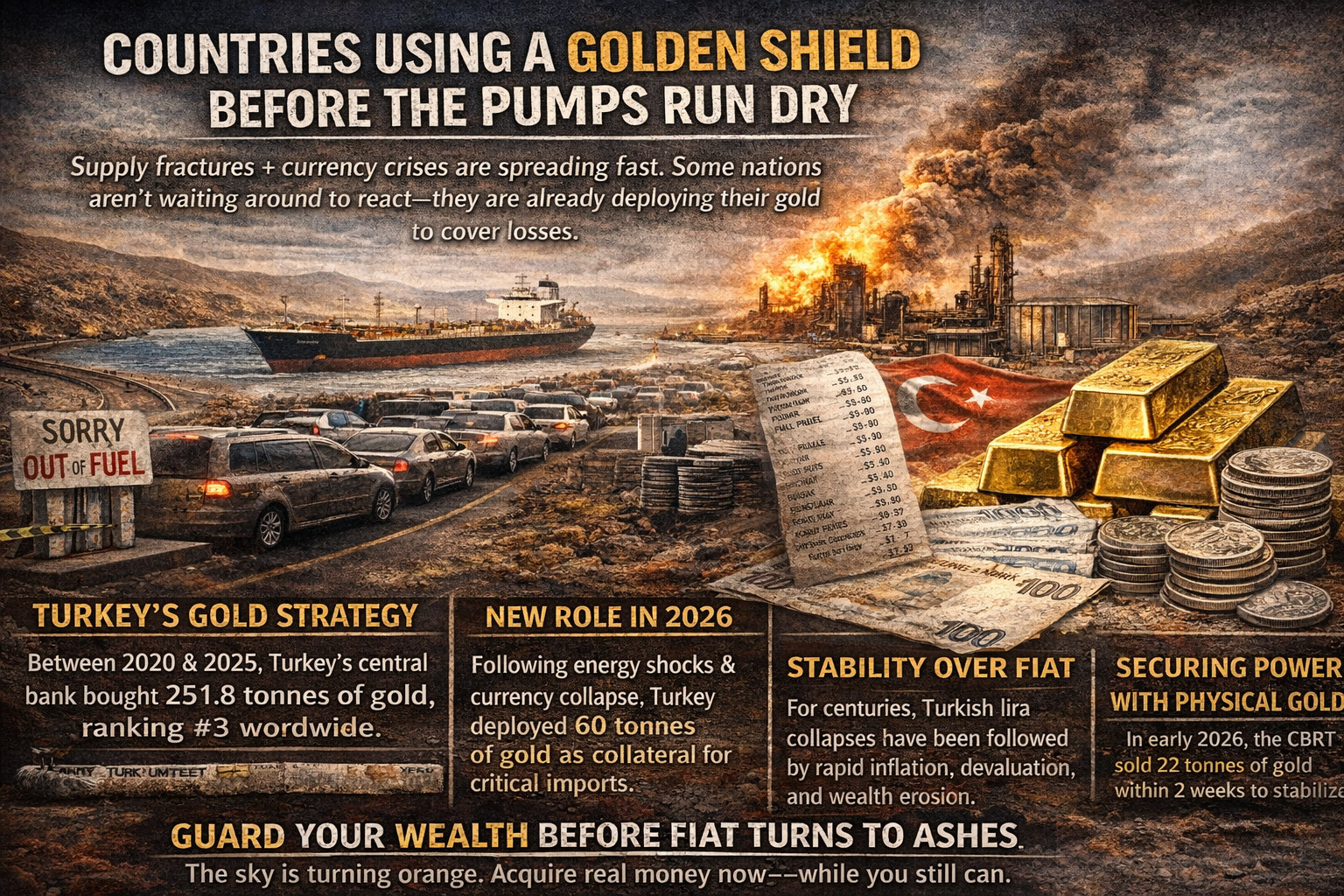
Turkey: A Masterclass in Gold as Real-World Collateral
No nation illustrates this strategy more vividly than Turkey.
Between 2020 and the end of 2025, Turkey ranked as the third-largest central bank gold buyer on the planet, adding a precise net 251.8 tonnes according to World Gold Council data – trailing only China and Poland. These were not speculative purchases. In late March 2026, as regional conflict erupted and energy costs surged, the Central Bank of the Republic of Türkiye (CBRT) mobilized roughly 60 tonnes of gold – valued at more than $8 billion USD – in the span of just two weeks. Of that total, approximately 22 tonnes were sold outright while the balance flowed into gold-for-FX and gold-for-lira swap arrangements. Gold shifted from reserve asset to operational lifeline, pledged as collateral to secure foreign exchange and defend the domestic currency at the moment of maximum strain.
Turkey required every gram. Since early 2020, when one U.S. dollar bought roughly six Turkish lira, the currency has collapsed. As of April 6, 2026, the exchange rate hovers near 44.6 TRY per USD – representing an approximate 86% loss in the lira’s value against the dollar. Over this period, the Turkish lira has consistently ranked among the very worst-performing major currencies globally, often the weakest or near-weakest in emerging-market league tables, battered by persistent high inflation and repeated bouts of acute devaluation. Its long decline stands as one of the starkest demonstrations of fiat vulnerability in the modern era.
Turkey accumulated gold aggressively during calmer stretches to construct a buffer for when the inevitable ultimately occurred. Then, when the lira buckled and energy shocks intensified, it deployed that gold in the real economy. This is the emerging template: gold serving simultaneously as deep-store insurance and immediate tactical ammunition.
France Signals the Same Strategic Shift from the Developed World
The instinct is not confined to emerging markets. In March 2026, the Banque de France announced the completion of its upgrade and full repatriation of the last 129 tonnes of gold previously held at the New York Federal Reserve. Conducted through a series of careful transactions between July 2025 and January 2026, the operation replaced older, non-standard bars with modern, Paris-compliant equivalents and generated a capital gain of €12.8 billion (approximately $15 billion USD). France’s entire official gold stock – now fully under sovereign control in its own vaults – reflects a calculated preference for physical ownership and operational autonomy when confidence in distant custodians or paper systems begins to erode.
The Worldwide Pattern Central Banks Are Quietly Establishing
The evidence has become impossible to dismiss. From 2020 through 2025, central banks collectively added thousands of tonnes of gold to their reserves. The most aggressive accumulators – China, Poland, Turkey, India, and several others – were not chasing short-term price momentum. They were positioning for the precise stresses now visible: tightening energy supplies, chronic currency erosion, and monetary frameworks that operate smoothly until they do not.
Energy fragility magnifies every vulnerability. A Nation dependent on imported oil or gas confront sudden foreign-exchange demands when supplies tighten. Currencies weaken. Inflation accelerates. Traditional reserves come under test. In such conditions, gold transcends its role as a mere store of value. It becomes the asset that can be pledged, swapped, or liquidated to purchase critical time while paper currencies hemorrhage value.
Central banks have cast their vote through balance-sheet decisions. They purchase during periods of relative calm and activate the metal when crises strike. Retail investors, by contrast, frequently delay until the queues lengthen or the next sharp devaluation unfolds leaving the many chasing after so few ounces.
The era of inexpensive, abundant fuel and implicit faith in fiat systems is drawing to a close – amid fire, smoke, and ruptured supply chains. The Turkish lira’s collapse reveals the human and economic cost when currencies fail decisively. Turkey’s gold playbook reveals the rational countermeasure: build the position first, then use it without hesitation when necessity demands.
Do not wait until the crisis reaches your local fuel station or erodes the purchasing power of your savings. Central banks are not waiting. They are acting while the majority still believes such disruptions remain distant or theoretical.
Acquire physical gold. Acquire it in meaningful quantity. Acquire it now – because the window that existed yesterday is already narrowing.
When supply fractures completely and additional fiat currencies waver, those holding tangible money will retain choices. The rest will stand beside empty pumps, clutching devalued paper.
The sky has already begun to turn that ominous orange in scattered corners of the world. Position yourself ahead of its arrival. The version of you living through what comes next will regard the decision as one of the wisest you ever made.