Hi,
Hi,

The World Is Running Out of Easy Gold
For years, the financial system survived on confidence alone. Central banks printed trillions, debt exploded beyond comprehension, and markets kept climbing as if resources were infinite. But beneath the surface, something dangerous has changed. The world is running out of available gold. Not gold in theory. Not digital gold. Physical gold.
Over the last 16 years, global miners have extracted roughly 52,000 tonnes of gold from the earth. That number sounds enormous until you realize demand is accelerating faster than supply can respond. Mines are deeper, discoveries are rarer, production costs are soaring, and permitting new projects has become painfully slow. Yet despite all this mining activity, it still is not enough.
Analysts are now warning about a projected gold deficit moving into 2026 as demand collides with tightening physical supply. Some institutional forecasts suggest the gap between newly mined supply and total global demand could reach several hundred tonnes annually, with mine production expected to remain near 3,700 tonnes while combined central bank, investment, industrial, and jewelry demand continues pushing far beyond that level. Central banks continue buying aggressively in an attempt to reduce dependence on weakening fiat systems. Nations that once trusted paper reserves are now racing to secure hard assets before everyone else does.
At the same time, Wall Street firms are raising gold price targets again and again. Institutions that ignored precious metals for years are suddenly treating physical gold as strategic infrastructure. Which should concern people because Wall Street does not chase safety assets unless it sees instability ahead.
Central Banks Are Hoarding While the Public Watches
Global central bank demand has remained near historic highs as governments quietly compete for finite supply. The message being sent behind closed doors is becoming impossible to ignore. Trust between nations is deteriorating, debt levels are spiraling out of control, and confidence in paper currency is weakening.
Gold is no longer being treated as a relic. It is being treated as insurance against systemic failure.
Meanwhile, another pressure point is emerging from an unexpected direction. Artificial intelligence. The AI boom is creating massive new infrastructure demand across the globe. Data centres require enormous amounts of high-performance electronics, power systems, and advanced technology components. As governments and corporations race to dominate AI development, demand for critical materials is surging alongside it.
Even the jewelry market is changing. Across multiple regions, jewelry is increasingly being melted down and refined into high purity bars and coins as investment demand spikes. Families that once purchased gold for culture and celebration are now buying it for protection. That transition matters because it signals fear. People do not melt jewelry into investment bullion when they feel optimistic about the future. They do it when they believe the financial system ahead may look very different from the one behind them.
Tether Is Buying More Gold Than China
One of the clearest warning signs is not coming from the government. It is coming from the digital currency world.
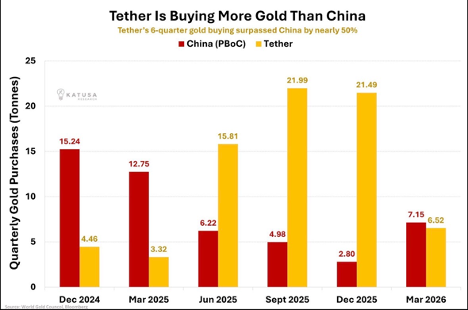
According to recent figures, Tether’s six quarter gold accumulation reached approximately 73.6 tonnes, surpassing China’s reported purchases of roughly 49.1 tonnes over the same period by nearly 50%. That should stop people in their tracks. A private digital token company is now buying more physical gold than one of the most powerful nations on earth. This is not symbolic. It is strategic. Tether understands something the broader public still does not fully grasp. Digital currencies may dominate the future because of speed and efficiency, but digital systems without hard asset backing eventually collapse into the same trap as modern fiat currencies: unlimited creation, unlimited dilution, and unlimited loss of trust.
Every digital token ultimately depends on confidence. And confidence disappears quickly when there is nothing tangible underneath it. That is why physical gold matters. Not because it is old, but because it cannot be printed.
The fact that Tether is aggressively accumulating gold while governments, banks, and institutions are doing the same reveals a global shift already underway. The financial world is quietly rebuilding itself around real assets while the public remains distracted by short term headlines and market noise. The frightening part is that there may not be enough supply available once panic fully arrives. The world is already mining gold as fast as possible, and it is still not enough. Central banks are buying. Private institutions are buying. Digital currency giants are buying. Investors are melting jewelry into bars and coins. And Wall Street is preparing for higher prices.
History shows that when trust in currency begins to fracture, populations move toward tangible wealth at astonishing speed. By the time the average person realizes what is happening, access becomes harder, premiums rise violently, and supply dries up.
That moment may be approaching far faster than most people believe.