Hi,
Hi,

History rarely announces itself. It whispers… until suddenly it roars.
The greatest financial shifts are often invisible until they are irreversible. By the time the headlines acknowledge them, fortunes have already changed hands. Today, the warning signs are everywhere: physical silver is commanding dramatically higher prices across Asia, governments are building new gold settlement systems outside Western control, central banks are accumulating gold at a pace not seen in modern history, and U.S. stock valuations have climbed to levels exceeding every major financial bubble on record.
Individually, these developments are noteworthy. Together, they tell a story that investors cannot afford to ignore.
Silver Is Worth More Everywhere Except Where It Is Priced
The world’s pricing of silver has become increasingly fractured. While silver trades for roughly $65 USD per ounce in the United States, buyers across Asia are paying substantially more for the same metal.
- United States: $65 USD/oz
- China: $75.35 USD/oz (+15.93%)
- India: $79.60 USD/oz (+22.46%)
- Japan: $90–130 USD/oz (+38.46 – 100%)
This is more than a pricing anomaly; it is a signal. Markets ultimately send products to where they are valued the most. When one region consistently undervalues a scarce asset while another willingly pays a premium, that asset naturally migrates toward the higher bidder.
That is exactly what is happening today.
Physical silver continues flowing eastward as Western markets remain largely focused on leveraged paper contracts rather than physical ownership. Meanwhile, nations across Asia appear increasingly willing to secure real metal regardless of price. The implication is difficult to ignore: the West may still determine the paper price, but the East is increasingly determining where the metal ultimately resides. When supply becomes constrained, price discovery has a way of changing very quickly.
The Financial Rails Are Being Rebuilt and They’re Heading East
For generations, London has stood at the centre of the global precious metals market through the London Bullion Market Association (LBMA).
That dominance is now facing its most credible challenge in decades. Both Hong Kong and Singapore have announced government-backed gold clearing initiatives designed to create alternative infrastructure for settling physical gold trades. These are not simply new exchanges — they are foundational pieces of financial plumbing.
Think of them as new railway tracks being laid beneath the global monetary system. Whoever controls the settlement infrastructure ultimately controls the flow of capital. As these new clearing systems mature, physical gold will increasingly move through Eastern financial hubs rather than Western ones. Liquidity follows infrastructure, and infrastructure shapes markets for generations.
This is not merely a change in geography. It represents the gradual transfer of financial influence from West to East.
The metal is moving east.
The vaults are moving east.
Now the settlement systems are moving east as well.
Central Banks Are Sending the Clearest Signal of All
If there is one group that understands the importance of monetary reserves, it is central banks, and their actions speak louder than any headline.
According to the latest World Gold Council survey of 74 central banks:
- 45% plan to increase their gold reserves over the next 12 months. The highest percentage ever recorded.
- That figure has more than doubled since 2020, marking the third consecutive annual increase.
- Among emerging market and developing economies, a record 53% intend to purchase additional gold.
- 89% of central banks expect global official gold reserves to rise over the coming year. The second-highest reading ever recorded.
Perhaps most telling is when they are buying.
Rather than waiting for higher prices, central banks have been purchasing aggressively during price pullbacks. They are buying weakness, not chasing strength. Behavior that reflects conviction. Unlike short-term traders, central banks measure wealth preservation in decades and not months. Their continued accumulation suggests they see gold not as a speculative asset, but as an increasingly important monetary reserve in a changing global financial order. When the institutions responsible for safeguarding national wealth continue exchanging paper currency for physical gold, individual investors should at least ask why.
Stocks Have Never Been More Expensive
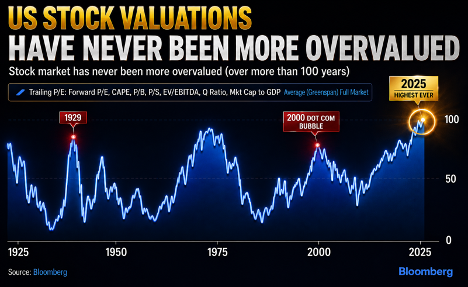
The accompanying Bloomberg chart presents one of the most striking valuations ever recorded. By combining multiple valuation metrics including Price-to-Earnings, CAPE Ratio, Price-to-Sales, Market Cap-to-GDP, Enterprise Value and others, the data shows U.S. equities have now reached the highest valuation percentile in more than 100 years of market history.
Higher than 1929 at the peak of the Great Depression.
Higher than the Dot-Com Bubble.
Higher than any previous market peak on record.
While elevated valuations alone do not predict an immediate correction, history consistently demonstrates that periods of extreme optimism often precede periods of disappointment. Markets eventually reconnect with underlying fundamentals. The further valuations stretch beyond historical norms, the greater the potential adjustment when sentiment changes.
At the same time stocks sit at historically expensive levels, precious metals continue to represent a remarkably small allocation within most investment portfolios. Which, if you look closely, you will find that history has a habit of rewarding what is ignored and punishing what becomes universally loved.
Quiet Signals Become Loud Headlines
Major financial transitions rarely occur overnight. They unfold piece by piece until one day the evidence becomes impossible to ignore.
- Silver commands far higher prices across Asia than it does in the West.
- New government-backed gold clearing systems are emerging outside London’s traditional sphere of influence.
- Central banks are accumulating gold at record levels and expect that to continue.
- Meanwhile, U.S. equity markets sit at valuation extremes never before witnessed in modern financial history.
None of these developments guarantee what tomorrow will bring. But together, they paint a compelling picture of a world quietly repositioning for a different monetary future.
The question every investor must answer is simple:
When history looks back on this period, will it remember those who recognized the shift or those who waited for the headlines after the opportunity had already passed?