Hi,
Hi,

The world is waking up to the harsh reality of an energy crunch that began with the U.S.-Israeli conflict against Iran and the severe supply disruption of the Strait of Hormuz. Once a distant headline, the crisis is now carving deep scars across import-dependent regions while the West watches prices climb and wonders how long its relative insulation from energy shocks will last. This newsletter breaks down the hotspots where fuel is already rationed or running dry, the inflationary wildfire this has the potential to ignite, and why the resulting market volatility is quietly transferring real wealth into fewer hands through precious metals.
Fuel Crisis Hotspots: Rationing, Empty Reserves, and Panic on the Ground
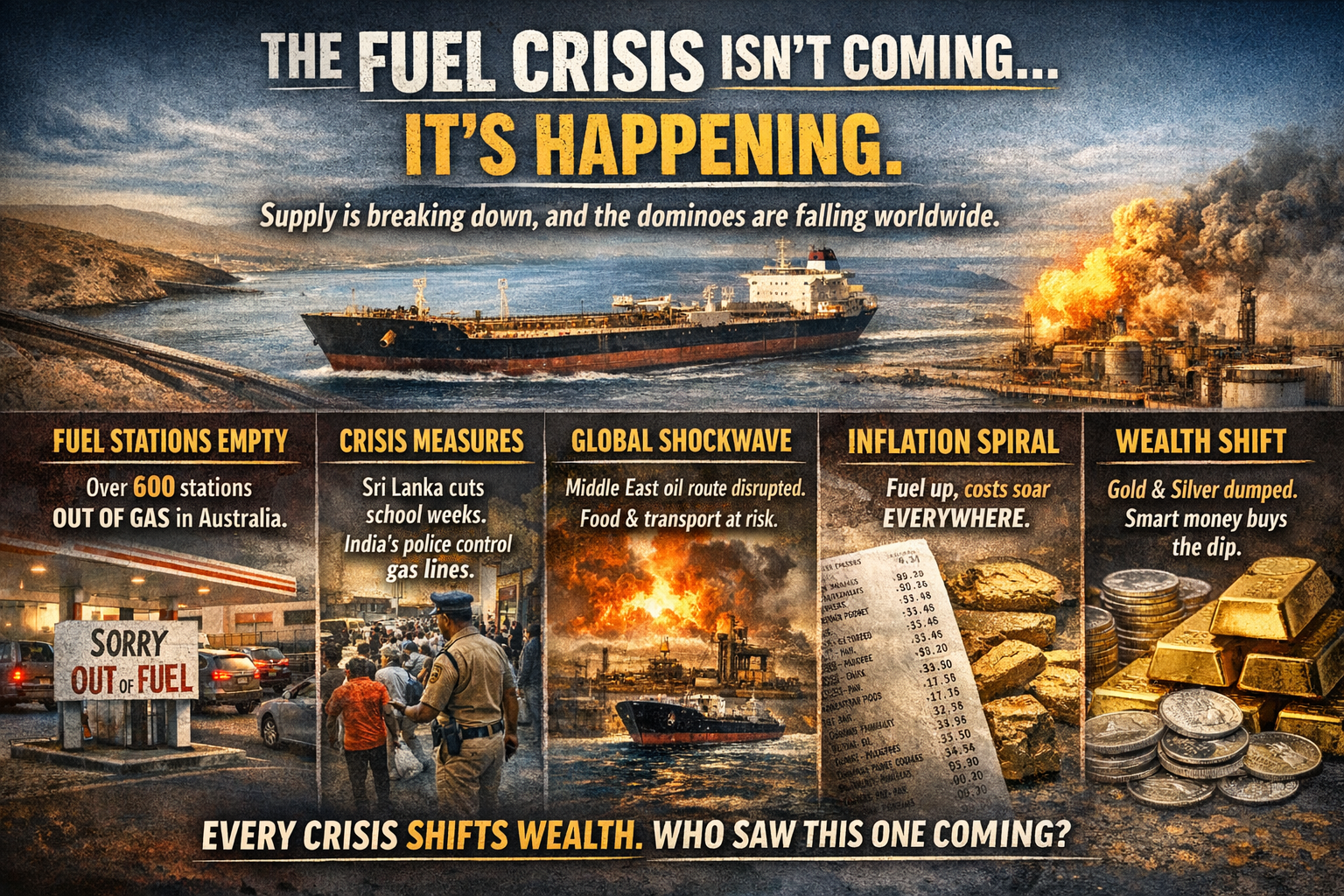
The crisis has struck hardest where nations rely most heavily on seaborne oil from the Middle East. In the Asia-Pacific, the pain is immediate and visible. Australia has seen more than 600 service stations run out of at least one fuel grade and diesel shortages are especially brutal in rural New South Wales, Victoria, and Queensland, where farmers and truckers face empty pumps during harvest season. Panic buying has pushed demand up 25-40 percent in some places, forcing gas stations to impose purchase caps and jerry-can bans. Sri Lanka has introduced four-day school weeks and slashed public services to stretch dwindling diesel stocks. India’s police now patrol queues at petrol stations, while China has banned fuel exports outright to safeguard domestic supplies. Pakistan and the Philippines have declared national energy emergencies, with rolling blackouts occurring causing rationing measures to already be put in circulation.
Europe is next in line. Refiners warn that diesel and jet-fuel stocks could hit critical lows by April (only days away) if Hormuz flows do not resume, prompting governments to draw on strategic reserves and quietly prepare conservation campaigns reminiscent of the 1970s. In parts of Africa, Mauritius has imposed energy-saving curfews and South Sudan is rationing electricity tied to fuel shortages for generators.
Meanwhile, the United States and Canada have so far felt the crisis mainly through the wallet with gasoline nearing or exceeding $4 a gallon in many areas ($1.60-$2 CAD per litre), with diesel climbing faster. Strategic reserves have been tapped, but no widespread gas station outages have occurred yet. The West’s buffer is real for now, but razor-thin: global supply chains for food, fertilizer, plastics, and freight run on oil, and the clock is ticking.
The Inflationary Inferno: Parallels to the 1970s Energy Crisis
This is not just a fuel story; it is an inflation story in the making. The world’s economy remains addicted to cheap, abundant oil. When that supply is choked, costs cascade through every sector: higher diesel means costlier trucking, shipping, and farming; fertilizer prices soar; plastics and chemicals follow. The result is broad-based price pressure that central banks cannot easily tame.
Flash back to the 1970s oil crisis. In 1973 the OPEC embargo and in 1979 the Iranian Revolution triggered supply shocks that sent oil prices soaring dramatically. The West responded with gas lines, odd-even rationing, Sunday driving bans, and thermostats turned down. Inflation exploded into double digits nearing 20% in the U.S. and Europe, stagflation took hold, and central banks eventually slammed the brakes with sky-high interest rates that triggered brutal recessions. Unemployment spiked while grocery bills kept rising steadily.
Today’s parallels are uncanny. Once again, a Middle East chokepoint is the trigger. Once again strategic reserves (including the IEA’s largest-ever 400-million-barrel release) are being drained at record speed. And once again the world’s just-in-time supply chains have almost no slack. Economists already forecast that sustained high oil prices could add significantly to global inflation within months. For households across North America and beyond, that means pricier groceries, heating bills, and everyday transport long before any new supply routes open. The 1970s taught us that energy shocks do not fade quickly; they reshape economies for years.
Precious Metals in the Volatility Storm: Forced Sales, Bargain Hunters, and the Wealth Transfer
Energy turmoil never travels alone – it breeds financial volatility that forces margin calls across leveraged portfolios. When prices swing wildly, overextended traders and funds must post cash or collateral immediately. The most liquid assets are sold first: gold and silver. In March, both metals have faced sharp selling pressure amid these liquidity demands, gold down 15% and silver down 23.5%.
Yet the story is not one of collapse but of opportunity in disguise. Those forced to sell are handing over physical metal and futures contracts at discounted prices. Meanwhile, patient buyers like family offices, central banks, and high-net-worth individuals who understand the bigger picture are scooping up the dip hand over fist. Silver, in particular, is being accumulated aggressively because its industrial uses (solar, electronics, EVs) will only grow as the energy transition collides with oil scarcity. Gold on the other hand remains the ultimate store of value when fiat currencies face severe depreciation from over-printing.
This is a classic wealth transfer in action: the leveraged and the panicked sell low, while the disciplined and the informed buy low. Real assets are quietly migrating into fewer, stronger hands ahead of what many analysts call the coming financial reset – when decades of easy money, debt, and just-in-time systems finally meet their limits.
The Calm Before the Broader Storm
The fuel crisis has already redrawn daily life across Asia and Australia. The West still enjoys full pumps and lights-on convenience, but the higher prices at the till are only the opening act. History’s energy shocks show us how quickly comfort can turn to constraint, how inflation can embed itself, and how volatility can accelerate the concentration of real wealth. The window to prepare – whether by securing essentials, conserving where possible, or positioning in undervalued hard assets like gold and silver – is still open, but it is narrowing fast. Stay alert, stay informed, and remember in times like these, the greatest risk is assuming the status quo will hold forever.